ThyCa:  Thyroid Cancer
Survivors' Association, Inc.
 

SUPPORT SERVICES
Newly Diagnosed
Find Support
Conferences/Workshops
Calendar of Events
    HTML
Low Iodine Cookbook
Newsletters
Resource List
Humor

New Patient Packet - Free
Guestbook

ABOUT
THYROID CANCER
Reference Book
Thyroid Cancer Facts
Thyroid Cancer Types
   Anaplastic Thyroid Cancer
   Medullary Thyroid Cancer
Pediatric Thyroid Cancer
Lab Tests/Nodules
Radiation: RAI  EBR
Low Iodine Diet
Low Iodine Cookbook
After Receiving RAI
ATA Guidelines
Clinical Trials
Links

HOW TO HELP
Become a Member
Volunteer
Donate to ThyCa
Research Funds

Give a Tribute Card

Raise Awareness
ThyCa Merchandise

ABOUT ThyCa
News
History
Medical Advisors
Directors HTML
Fact Sheet
Annual Report

Intro for Physicians

En Español

SEARCH THYCA

CONTACT US

To view files, you need Adobe Acrobat Reader.

download tips

NCI Overview: What You Need to Know About Thyroid Cancer
Information about detection, symptoms, diagnosis, and treatment
of thyroid cancer.

NIH Publication No. 01-4994
Posted on the National Cancer Institute web site: 02/08/2002,
Updated: 09/16/2002

The Thyroid
Understanding Cancer
Benign or malignant
Major types of thyroid cancer
Who's at risk?

Symptoms
Diagnosis
Staging
Treatment

Getting a Second Opinon
Preparing for Treatment
Methods of Treatment
Side Effects of Cancer Treatment
Radioactive Iodine (I-131) Therapy
Hormone Treatment
External Radiation Therapy
Chemotherapy

The Thyroid

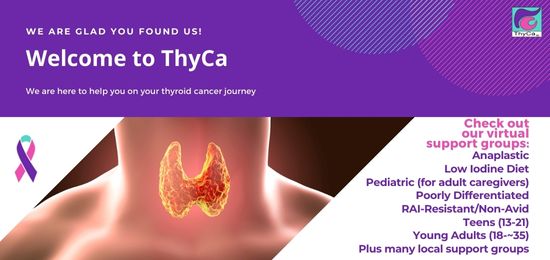
The thyroid is a gland in the neck. It has two kinds of cells that make hormones. Follicular cells make thyroid hormone, which affects heart rate, body temperature, and energy level. C cells make calcitonin, a hormone that helps control the level of calcium in the blood.

The thyroid is shaped like a butterfly and lies at the front of the neck, beneath the voice box (larynx). It has two parts, or lobes. The two lobes are separated by a thin section called the isthmus.

A healthy thyroid is a little larger than a quarter. It usually cannot be felt through the skin. A swollen lobe might look or feel like a lump in the front of the neck. A swollen thyroid is called a goiter. Most goiters are caused by not enough iodine in the diet. Iodine is a substance found in shellfish and iodized salt.

Understanding Cancer

Cancer is a group of many related diseases. All cancers begin in cells, the body's basic unit of life. Cells make up tissues, and tissues make up the organs of the body.

Normally, cells grow and divide to form new cells as the body needs them. When cells grow old and die, new cells take their place.

Sometimes this orderly process goes wrong. New cells form when the body does not need them, and old cells do not die when they should. These extra cells can form a mass of tissue called a growth or tumor. Growths on the thyroid are usually called nodules.

Thyroid nodules can be benign or malignant.

Benign nodules are not cancer. Cells from benign nodules do not spread to other parts of the body. They are usually not a threat to life. Most thyroid nodules (more than 90 percent) are benign.

Malignant nodules are cancer. They are generally more serious and may sometimes be life threatening. Cancer cells can invade and damage nearby tissues and organs. Also, cancer cells can break away from a malignant nodule and enter the bloodstream or the lymphatic system. That is how cancer spreads from the original cancer (primary tumor) to form new tumors in other organs. The spread of cancer is called metastasis.

The following are the major types of thyroid cancer:

-Papillary and follicular thyroid cancers account for 80 to 90 percent of all thyroid cancers. Both types begin in the follicular cells of the thyroid. Most papillary and follicular thyroid cancers tend to grow slowly. If they are detected early, most can be treated successfully.

-Medullary thyroid cancer accounts for 5 to 10 percent of thyroid cancer cases. It arises in C cells, not follicular cells. Medullary thyroid cancer is easier to control if it is found and treated before it spreads to other parts of the body.

-Anaplastic thyroid cancer is the least common type of thyroid cancer (only 1 to 2 percent of cases). It arises in the follicular cells. The cancer cells are highly abnormal and difficult to recognize. This type of cancer is usually very hard to control because the cancer cells tend to grow and spread very quickly.

If thyroid cancer spreads (metastasizes) outside the thyroid, cancer cells are often found in nearby lymph nodes, nerves, or blood vessels. If the cancer has reached these lymph nodes, cancer cells may have also spread to other lymph nodes or to other organs, such as the lungs or bones.

When cancer spreads from its original place to another part of the body, the new tumor has the same kind of abnormal cells and the same name as the primary tumor. For example, if thyroid cancer spreads to the lungs, the cancer cells in the lungs are thyroid cancer cells. The disease is metastatic thyroid cancer, not lung cancer. It is treated as thyroid cancer, not as lung cancer. Doctors sometimes call the new tumor "distant" or metastatic disease.

Thyroid Cancer: Who's at Risk?

No one knows the exact causes of thyroid cancer. Doctors can seldom explain why one person gets this disease and another does not. However, it is clear that thyroid cancer is not contagious. No one can "catch" cancer from another person.

Research has shown that people with certain risk factors are more likely than others to develop thyroid cancer. A risk factor is anything that increases a person's chance of developing a disease.

The following risk factors are associated with an increased chance of developing thyroid cancer:

-Radiation. People exposed to high levels of radiation are much more likely than others to develop papillary or follicular thyroid cancer.

One important source of radiation exposure is treatment with x-rays. Between the 1920s and the 1950s, doctors used high-dose x-rays to treat children who had enlarged tonsils, acne, and other problems affecting the head and neck. Later, scientists found that some people who had received this kind of treatment developed thyroid cancer. (Routine diagnostic x-rays -- such as dental x-rays or chest x-rays -- use very small doses of radiation. Their benefits nearly always outweigh their risks. However, repeated exposure could be harmful, so it is a good idea for people to talk with their dentist and doctor about the need for each x-ray and to ask about the use of shields to protect other parts of the body.)

Another source of radiation is radioactive fallout. This includes fallout from atomic weapons testing (such as the testing in the United States and elsewhere in the world, mainly in the 1950s and 1960s), nuclear power plant accidents (such as the Chornobyl [also called Chernobyl] accident in 1986), and releases from atomic weapons production plants (such as the Hanford facility in Washington state in the late 1940s). Such radioactive fallout contains radioactive iodine (I-131). People who were exposed to one or more sources of I-131, especially if they were children at the time of their exposure, may have an increased risk for thyroid diseases.

People who are concerned about their exposure to radiation from medical treatments or radioactive fallout may wish to ask the Cancer Information Service at 1-800-4-CANCER about additional sources of information.

-Family history. Medullary thyroid cancer can be caused by a change, or alteration, in a gene called RET. The altered RET gene can be passed from parent to child. Nearly everyone with the altered RET gene will develop medullary thyroid cancer. A blood test can detect an altered RET gene. If the abnormal gene is found in a person with medullary thyroid cancer, the doctor may suggest that family members be tested. For those found to carry the altered RET gene, the doctor may recommend frequent lab tests or surgery to remove the thyroid before cancer develops. When medullary thyroid cancer runs in a family, the doctor may call this "familial medullary thyroid cancer" or "multiple endocrine neoplasia (MEN) syndrome." People with the MEN syndrome tend to develop certain other types of cancer.

A small number of people with a family history of goiter or certain precancerous polyps in the colon are at risk for developing papillary thyroid cancer.

-Being female. In the United States, women are two to three times more likely than men to develop thyroid cancer.

-Age. Most patients with thyroid cancer are more than 40 years old. People with anaplastic thyroid cancer are usually more than 65 years old.

-Race. In the United States, white people are more likely than African Americans to be diagnosed with thyroid cancer.

-Not enough iodine in the diet. The thyroid needs iodine to make thyroid hormone. In the United States, iodine is added to salt to protect people from thyroid problems. Thyroid cancer seems to be less common in the United States than in countries where iodine is not part of the diet.

Most people who have known risk factors do not get thyroid cancer. On the other hand, many who do get the disease have none of these risk factors. People who think they may be at risk for thyroid cancer should discuss this concern with their doctor. The doctor may suggest ways to reduce the risk and can plan an appropriate schedule for checkups.

Symptoms

Early thyroid cancer often does not cause symptoms. But as the cancer grows, symptoms may include:

-A lump, or nodule, in the front of the neck near the Adam's apple;
-Hoarseness or difficulty speaking in a normal voice;
-Swollen lymph nodes, especially in the neck;
-Difficulty swallowing or breathing; or
-Pain in the throat or neck.

These symptoms are not sure signs of thyroid cancer. An infection, a benign goiter, or another problem also could cause these symptoms. Anyone with these symptoms should see a doctor as soon as possible. Only a doctor can diagnose and treat the problem.

Diagnosis

If a person has symptoms that suggest thyroid cancer, the doctor may perform a physical exam and ask about the patient's personal and family medical history. The doctor also may order laboratory tests and imaging tests to produce pictures of the thyroid and other areas.

The exams and tests may include the following:

-Physical exam -- The doctor will feel the neck, thyroid, voice box, and lymph nodes in the neck for unusual growths (nodules) or swelling.

-Blood tests -- The doctor may test for abnormal levels (too low or too high) of thyroid-stimulating hormone (TSH) in the blood. TSH is made by the pituitary gland in the brain. It stimulates the release of thyroid hormone. TSH also controls how fast thyroid follicular cells grow.

If medullary thyroid cancer is suspected, the doctor may check for abnormally high levels of calcium in the blood. The doctor also may order blood tests to detect an altered RET gene or to look for a high level of calcitonin.

-Ultrasonography -- The ultrasound device uses sound waves that people cannot hear. The waves bounce off the thyroid, and a computer uses the echoes to create a picture called a sonogram. From the picture, the doctor can see how many nodules are present, how big they are, and whether they are solid or filled with fluid.

-Radionuclide scanning -- The doctor may order a nuclear medicine scan that uses a very small amount of radioactive material to make thyroid nodules show up on a picture. Nodules that absorb less radioactive material than the surrounding thyroid tissue are called cold nodules. Cold nodules may be benign or malignant. Hot nodules take up more radioactive material than surrounding thyroid tissue and are usually benign.

-Biopsy -- The removal of tissue to look for cancer cells is called a biopsy. A biopsy can show cancer, tissue changes that may lead to cancer, and other conditions. A biopsy is the only sure way to know whether a nodule is cancerous.

The doctor may remove tissue through a needle or during surgery:

-Fine-needle aspiration: For most patients, the doctor removes a sample of tissue from a thyroid nodule with a thin needle. A pathologist looks at the cells under a microscope to check for cancer. Sometimes, the doctor uses an ultrasound device to guide the needle through the nodule.

-Surgical biopsy: If a diagnosis cannot be made from the fine-needle aspiration, the doctor may operate to remove the nodule. A pathologist then checks the tissue for cancer cells.

Staging

If the diagnosis is thyroid cancer, the doctor needs to know the stage, or extent, of the disease to plan the best treatment. Staging is a careful attempt to learn whether the cancer has spread and, if so, to what parts of the body.

The doctor may use ultrasonography, magnetic resonance imaging (MRI), or computed tomography (CT) to find out whether the cancer has spread to the lymph nodes or other areas within the neck. The doctor may use a nuclear medicine scan of the entire body, such as a radionuclide scan known as the "diagnostic I-131 whole body scan," or other imaging tests to learn whether thyroid cancer has spread to distant sites.

Treatment

People with thyroid cancer often want to take an active part in making decisions about their medical care. They want to learn all they can about their disease and their treatment choices. However, the shock and stress that people may feel after a diagnosis of cancer can make it hard for them to think of everything they want to ask the doctor. It often helps to make a list of questions before an appointment. To help remember what the doctor says, patients may take notes or ask whether they may use a tape recorder. Some also want to have a family member or friend with them when they talk to the doctor -- to take part in the discussion, to take notes, or just to listen.

The doctor may refer patients to doctors (oncologists) who specialize in treating cancer, or patients may ask for a referral. Specialists who treat thyroid cancer include surgeons, endocrinologists (some of whom are called thyroidologists because they specialize in thyroid diseases), medical oncologists, and radiation oncologists. Treatment generally begins within a few weeks after the diagnosis. There will be time for patients to talk with the doctor about treatment choices, get a second opinion, and learn more about thyroid cancer.

Getting a Second Opinion

Before starting treatment, the patient might want a second opinion about the diagnosis and the treatment plan. Some insurance companies require a second opinion; others may cover a second opinion if the patient or doctor requests it. Gathering medical records and arranging to see another doctor may take a little time. In most cases, a brief delay does not make treatment less effective.

Preparing for Treatment

The doctor can describe treatment choices and discuss the results expected with each treatment option. The doctor and patient can work together to develop a treatment plan that fits the patient's needs.

Treatment depends on a number of factors, including the type of thyroid cancer, the size of the nodule, the patient's age, and whether the cancer has spread.

People do not need to ask all of their questions or understand all of the answers at one time. They will have other chances to ask the doctor to explain things that are not clear and to ask for more information.

Methods of Treatment

Surgery is the most common treatment for thyroid cancer. The surgeon may remove all or part of the thyroid. The type of surgery depends on the type and stage of thyroid cancer, the size of the nodule, and the patient's age.

-Total thyroidectomy -- Surgery to remove the entire thyroid is called a total thyroidectomy. The surgeon removes the thyroid through an incision in the neck. Nearby lymph nodes are sometimes removed, too. If the pathologist finds cancer cells in the lymph nodes, it means that the disease could spread to other parts of the body. In a small number of cases, the surgeon removes other tissues in the neck that have been affected by the cancer. Some patients who have a total thyroidectomy also receive radioactive iodine or external radiation therapy.

-Lobectomy -- Some patients with papillary or follicular thyroid cancer may be treated with lobectomy. The lobe with the cancerous nodule is removed. The surgeon also may remove part of the remaining thyroid tissue or nearby lymph nodes. Some patients who have a lobectomy receive radioactive iodine therapy or additional surgery to remove remaining thyroid tissue.

Nearly all patients who have part or all of the thyroid removed will take thyroid hormone pills to replace the natural hormone.

Radioactive iodine therapy (also called radioiodine therapy) uses radioactive iodine (I-131) to destroy thyroid cancer cells anywhere in the body. The therapy usually is given by mouth (liquid or capsules) in a small dose that causes no problems for people who are allergic to iodine. The intestine absorbs the I-131, which flows through the bloodstream and collects in thyroid cells. Thyroid cancer cells remaining in the neck and those that have spread to other parts of the body are killed when they absorb I-131.

If the dose of I-131 is low enough, the patient usually receives I-131 as an outpatient. If the dose is high, the doctor may protect others from radiation exposure by isolating the patient in the hospital during the treatment. Most radiation is gone in a few days. Within 3 weeks, only traces of radioactive iodine remain in the body.

Patients with medullary thyroid cancer or anaplastic thyroid cancer generally do not receive I-131 treatment. These types of thyroid cancer rarely respond to I-131 therapy.

Hormone treatment after surgery is usually part of the treatment plan for papillary and follicular cancer. When a patient takes thyroid hormone pills, the growth of any remaining thyroid cancer cells slows down, which lowers the chance that the disease will return.

After surgery or I-131 therapy (which removes or destroys thyroid tissue), people with thyroid cancer may need to take thyroid hormone pills to replace the natural thyroid hormone.

External radiation therapy (also called radiotherapy) uses high-energy rays to kill cancer cells. A large machine directs radiation at the neck or at parts of the body where the cancer has spread.

External radiation therapy is local therapy. It affects cancer cells only in the treated area. External radiation therapy is used mainly to treat people with advanced thyroid cancer that does not respond to radioactive iodine therapy. For external radiation therapy, patients go to the hospital or clinic, usually 5 days a week for several weeks. External radiation may also be used to relieve pain or other problems.

Chemotherapy, the use of drugs to kill cancer cells, is sometimes used to treat thyroid cancer. Chemotherapy is known as systemic therapy because the drugs enter the bloodstream and travel throughout the body. For some patients, chemotherapy may be combined with external radiation therapy.

Side Effects of Cancer Treatment

Because cancer treatment may damage healthy cells and tissues, unwanted side effects sometimes occur. These side effects depend on many factors, including the type and extent of the treatment. Side effects may not be the same for each person, and they may even change from one treatment session to the next. Before treatment starts, the health care team will explain possible side effects and suggest ways to help the patient manage them.

Surgery

Patients are often uncomfortable for the first few days after surgery. However, medicine can usually control their pain. Patients should feel free to discuss pain relief with the doctor or nurse. It is also common for patients to feel tired or weak. The length of time it takes to recover from an operation varies for each patient.

After surgery to remove the thyroid and nearby tissues or organs, such as the parathyroid glands, patients may need to take medicine (thyroid hormone) or vitamin and mineral supplements (vitamin D and calcium) to replace the lost functions of these organs. In a few cases, certain nerves or muscles may be damaged or removed during surgery. If this happens, the patient may have voice problems or one shoulder may be lower than the other.

Radioactive Iodine (I-131) Therapy

Some patients have nausea and vomiting on the first day of I-131 therapy. Thyroid tissue remaining in the neck after surgery may become swollen and painful. If the thyroid cancer has spread to other parts of the body, the I-131 that collects there may cause pain and swelling.

Patients also may have a dry mouth or lose their sense of taste or smell for a short time after I-131 therapy. Chewing sugar-free gum or sucking on sugar-free hard candy may help.

During treatment, patients are encouraged to drink lots of water and other fluids. Because fluids help I-131 pass out of the body more quickly, the bladder's exposure to I-131 is reduced.

Because radioactive iodine therapy destroys the cells that make thyroid hormone, patients may need to take thyroid hormone pills to replace the natural hormone.

A rare side effect in men who received large doses of I-131 is loss of fertility. In women, I-131 may not cause loss of fertility, but some doctors suggest that women avoid pregnancy for one year after I-131 therapy.

Researchers have reported that a very small number of patients may develop leukemia years after treatment with high doses of I-131.

Hormone Treatment

Thyroid hormone pills seldom cause side effects. However, a few patients may get a rash or lose some of their hair during the first months of treatment.

The doctor will closely monitor the level of thyroid hormone in the blood during followup visits. Too much thyroid hormone may cause patients to lose weight and to feel hot and sweaty. It also may cause chest pain, cramps, and diarrhea. (The doctor may call this condition "hyperthyroidism.") If the thyroid hormone level is too low, the patient may gain weight, feel cold, and have dry skin and hair. (The doctor may call this condition "hypothyroidism.") If necessary, the doctor will adjust the dose so that the patient takes the right amount.

External Radiation Therapy

External radiation therapy may cause patients to become very tired as treatment continues. Resting is important, but doctors usually advise patients to try to stay as active as they can. In addition, when patients receive external radiation therapy, it is common for their skin to become red, dry, and tender in the treated area. When the neck is treated with external radiation therapy, patients may feel hoarse or have trouble swallowing. Other side effects depend on the area of the body that is treated. If chemotherapy is given at the same time, the side effects may worsen. The doctor can suggest ways to ease these problems.

Chemotherapy

The side effects of chemotherapy depend mainly on the specific drugs that are used. The most common side effects include nausea and vomiting, mouth sores, loss of appetite, and hair loss. Some side effects may be relieved with medicine.